
Landing Page vs. Website: Which Does Your Business Actually Need?
A practical comparison of landing pages, one-page websites, and multi-page websites—with a decision tree for choosing the right format.
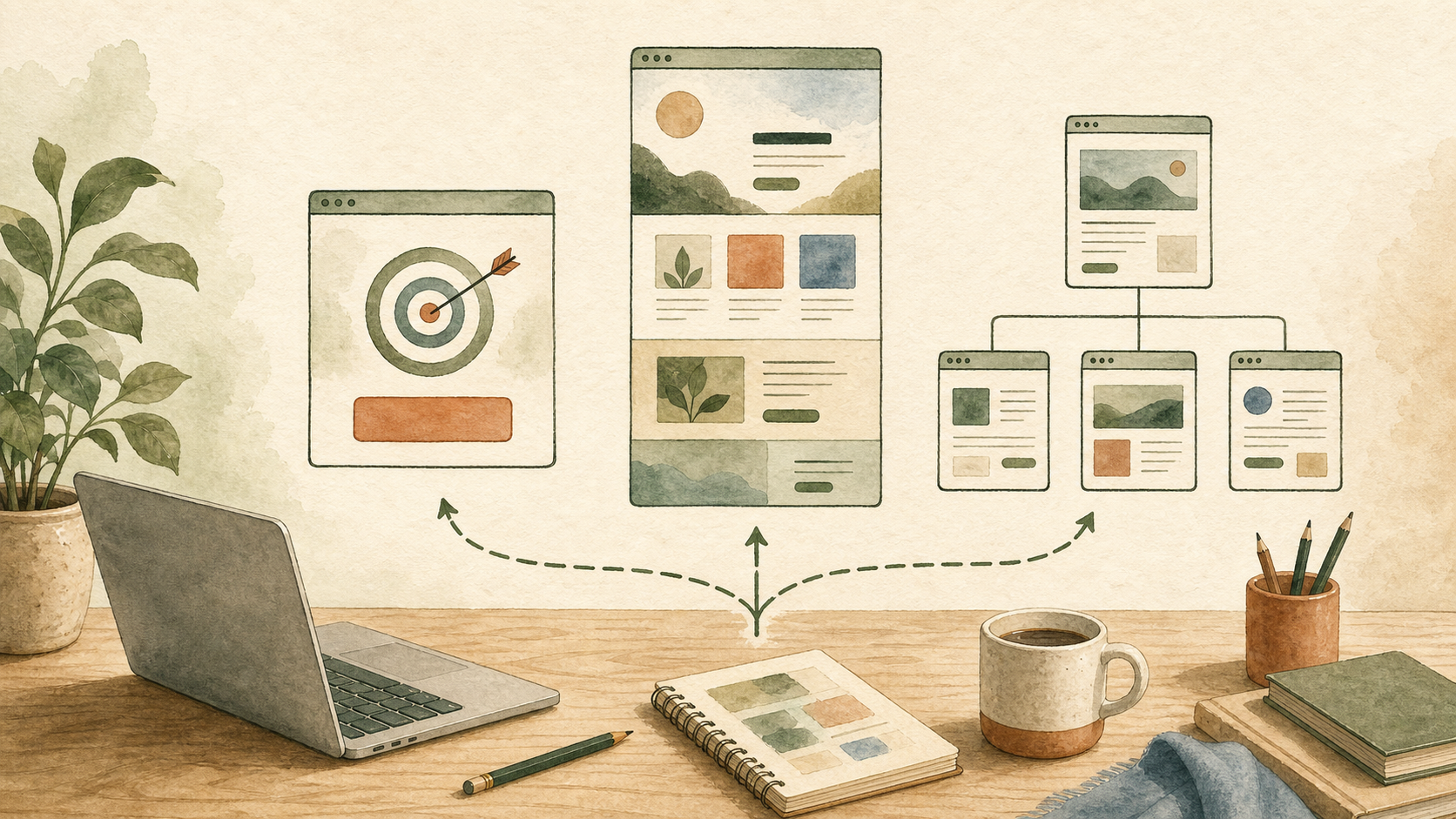
Short answer: Choose a landing page when one audience is arriving for one offer and you want one primary action. Choose a one-page website when the whole business is simple enough to explain in one useful scroll. Choose a multi-page website when people need to explore several services, products, locations, or questions before they decide. Many established businesses need both a website and separate landing pages for individual campaigns.
The difference is not whether the page is long, polished, or built with a particular platform. It is the job the page must do.
A landing page narrows the path. A website supports exploration. A one-page website sits between them: it represents the business, but keeps the scope compact.
Landing page vs. website vs. one-page website
These terms get used loosely, so start with the practical definitions.
Landing page
A landing page is built for a specific audience, offer, and action. The visitor commonly arrives from an ad, email, social post, QR code, event, or direct campaign link. The page might ask them to book, buy, register, request a quote, or join a list.
Google Ads defines a landing page as the page someone reaches after clicking an ad. Google also evaluates whether that page is useful, relevant, navigable, and consistent with what the ad led the visitor to expect. A page can be a landing page without paid ads, but the post-click idea is useful: the page continues a specific conversation.
One-page website
A one-page website represents the business itself on one main scrolling page. It can contain an introduction, services, about information, proof, FAQs, and a contact path. It may use a small menu that jumps to sections on the page.
Unlike a campaign landing page, it usually serves more than one traffic source and answers broader questions about the business. Unlike a multi-page website, it does not give every service or topic a separate URL.
Multi-page website
A multi-page website uses a homepage plus separate pages for services, products, locations, about information, resources, contact details, or other distinct needs.
Its job is not to push every visitor toward the same action immediately. It helps people find the part of the business that matters to them, gather enough information, and take an appropriate next step.
Use this three-outcome decision tree
Start at the top and stop when a recommendation fits.
Question 1: Is this for one specific campaign, offer, and audience?
Examples include a paid-search campaign for one service, an event registration, a product launch, a limited promotion, a lead magnet, or a booking campaign.
- Yes: Build a landing page.
- No: Continue to Question 2.
Question 2: Can the whole business be explained clearly on one page?
This can work when the business has one main offer, one primary audience, a short buying process, and limited content needs.
- Yes: Build a one-page website.
- No: Continue to Question 3.
Question 3: Do visitors need to compare several offers, research different topics, or find distinct location or product information?
- Yes: Build a multi-page website.
- Not yet: Start with a one-page website, but plan the navigation and platform so it can expand cleanly.
One final check: do you already have a website?
If you have a useful website and are starting a focused campaign, do not replace the site. Add a landing page for that campaign. The website provides the broader trust and research layer; the landing page provides a direct campaign path.
The practical comparison
| Dimension | Landing page | One-page website | Multi-page website |
|---|---|---|---|
| Primary purpose | Move one audience toward one action | Represent a simple business compactly | Represent and grow a broader business |
| Offers | One campaign or offer | Usually one core offer or a small related set | Several services, products, audiences, or locations |
| Navigation | Minimal; sometimes none beyond required links | Section links or a small menu | Full navigation among distinct pages |
| Search scope | One narrow topic or campaign | A small set of closely related terms | Separate pages can address distinct useful topics |
| Conversion focus | One primary call to action | One main action with limited supporting paths | Different actions for different visitor needs |
| Build scope | Smallest when content and offer are ready | Compact but must explain the whole business | Larger information, design, and QA scope |
| Cost | Usually the narrowest scoped build | Between a campaign page and broader site | Usually higher because more pages need strategy and upkeep |
| Maintenance | Update when the campaign changes or ends | Keep the entire business summary current | Maintain each page, link, offer, and conversion path |
| Tracking | Campaign source and one conversion | Overall visits and the main inquiry action | Page-level journeys and several conversion paths |
More pages do not automatically create stronger SEO. They create room for separate, useful pages. That only helps when the business has distinct subjects worth explaining and maintains those pages properly.
Choose a landing page when focus matters most
A landing page is the strongest fit when you can finish this sentence:
“This page is for this audience, arriving from this source, to consider this offer, and take this action.”
Good landing-page uses include:
- A Google Ads campaign for one service.
- An email campaign promoting one event.
- A new product or preorder.
- A consultation or estimate campaign.
- A downloadable resource.
- A seasonal offer with a defined end.
The page should match the message that brought the visitor there. Google’s landing-page guidance recommends aligning the page with the ad and keywords, making the intended action easy, designing for mobile, and providing useful original information.
What the landing page still needs
Focus does not mean stripping away information people need to trust the offer. A useful landing page normally includes:
- A clear promise that matches the campaign.
- Who the offer is for.
- The important benefits and scope.
- Honest proof or context available to the business.
- Relevant objections and answers.
- One primary form, booking, purchase, or contact action.
- A working confirmation and follow-up path.
- Analytics and conversion tracking.
If the offer is unclear, a rushed page will only make the uncertainty visible. Settle the audience, offer, action, and traffic plan before design begins.
Choose a one-page website when the business is genuinely simple
A one-page website can be enough for a consultant with one service, a new local business with a narrow offer, a portfolio with one contact goal, or a founder validating a straightforward idea.
It should still feel like a business website, not an ad that forgot to end. A strong one-page site usually contains:
- A plain-language description of the business.
- The main service or offer.
- Who it serves.
- A concise process or expectations section.
- Real proof when available.
- About and contact information.
- One obvious next step.
The risk is compression. When several services, audiences, and explanations are forced into one page, the visitor has to sort them out. Search engines also have one URL—not several distinct service pages—to understand and present.
Start with one page when the scope is truly small, not because every important question has been removed to meet a page limit.
Choose a multi-page website when people need depth
A multi-page website becomes the better foundation when:
- Services need different explanations, proof, or calls to action.
- Customers search for several distinct problems or products.
- The business serves several real locations with unique information.
- Buyers need detailed pricing, process, team, FAQ, or policy information.
- Content, resources, or search visibility will be an ongoing channel.
- Different audiences enter the site with different goals.
- The business expects the offer to expand.
Google’s SEO Starter Guide recommends organizing a site logically and creating useful content that matches what people need. Its link guidance explains how crawlable links help Google discover pages. A multi-page site can support that structure, but every page still needs a real purpose.
Before expanding, review what a small-business website actually needs. Clear messaging, working contact paths, search basics, measurement, and business ownership matter whether the site has one page or 50.
Most growing businesses need a website and landing pages
This is not always an either-or decision.
Use the website as the durable business home:
- Explain the full offer.
- Give each important service or product a useful place.
- Support branded and organic discovery.
- Hold the broader proof, company information, and resources.
Add landing pages when a campaign needs a tighter path:
- Match one ad group to one service.
- Give an event one registration experience.
- Send an email segment to an offer written for that segment.
- Test a new offer without rewriting the homepage.
Keep the landing page on the business’s domain when practical, and make ownership and tracking clear. Google Analytics supports campaign parameters that identify where campaign traffic came from; its campaign URL guidance explains the standard UTM fields.
Measure the format by the job it was given
Do not judge every page by total traffic.
For a landing page, measure:
- Qualified visits from the intended campaign.
- Form completions, bookings, purchases, or signups.
- Cost and lead quality when paid traffic is involved.
- Whether the confirmation and follow-up worked.
For a one-page website, measure:
- Whether visitors understand the offer.
- Contact, booking, or purchase actions.
- Which sections people reach and use.
- Search queries that reveal missing information.
For a multi-page website, measure:
- Which entry pages attract the right audience.
- How visitors move between service, proof, pricing, and contact pages.
- Which pages create qualified actions.
- Which important pages confuse visitors or go unseen.
Tracking cannot rescue a poor format choice, but it can show when the business has outgrown it.
Common mistakes when choosing
Building a landing page with five competing goals
If the page asks visitors to book, subscribe, browse every service, follow social accounts, and read the blog, it has become a crowded homepage. Choose the primary action and keep supporting links subordinate.
Building a full website before the offer is settled
More pages multiply undecided copy. When the business is still validating one offer, a one-page website or campaign page may produce faster learning with less material to rewrite.
Expecting one page to carry a broad search strategy
One strong page can be useful and searchable. It is still limited when the business needs separate, substantial answers for different services or customer questions.
Treating the homepage as every campaign’s destination
A homepage has to serve several types of visitors. When an ad or email makes a specific promise, a matching landing page can continue that promise without making the visitor search for it.
Choosing by page count instead of customer decisions
The right question is not “How many pages can I afford?” Ask how many distinct decisions and questions the site must support. Combine information that belongs together. Separate information that serves a different audience, search need, or action.
What should you build?
Choose the smallest format that completes the job without hiding information the customer needs.
- Landing page: one campaign, one audience, one offer, one primary action.
- One-page website: one compact business, one main audience, and limited information depth.
- Multi-page website: several meaningful offers, audiences, search topics, locations, or decision paths.
If your result is a focused campaign page, review Growing Pace’s 48-hour landing-page service. The timeline depends on a tight scope, ready content, quick feedback, account access, and availability.
If the business needs a broader, managed foundation, review Foundation website support and current pricing. If the decision tree still leaves you between two options, send the intake and describe the offer, traffic source, and deadline. We will recommend the smaller format when it can do the job.
Landing page vs. website FAQ
Can a landing page replace a website?
It can serve as a temporary or intentionally narrow web presence for one offer. It is not a full replacement when customers need to compare several services, research the business, find detailed information, or enter through different search topics.
Do I need a landing page if I already have a website?
Use one when a specific ad, email, event, launch, or audience needs a more focused message and action than the homepage provides. You do not need a separate landing page for every ordinary link.
Is a one-page website the same as a landing page?
Not necessarily. A one-page website summarizes the business and may support several visitor questions. A landing page is designed around one campaign or offer and one primary conversion action.
Which option is better for SEO?
The format alone does not decide. One useful page can earn search visibility for a focused topic. A multi-page site is more appropriate when the business has several distinct topics that each deserve a substantial page and clear internal links.
Sources and further reading
Free checklist
Not ready to send an intake yet?
Use the founder website checklist to spot the pages, trust signals, and systems your site needs before it can convert confidently.
Want us to handle this for your business?
Skip the DIY. Let one partner manage the digital side end to end.